

Labour Signals Direction - A Direct Attack on Woke Civil Service?

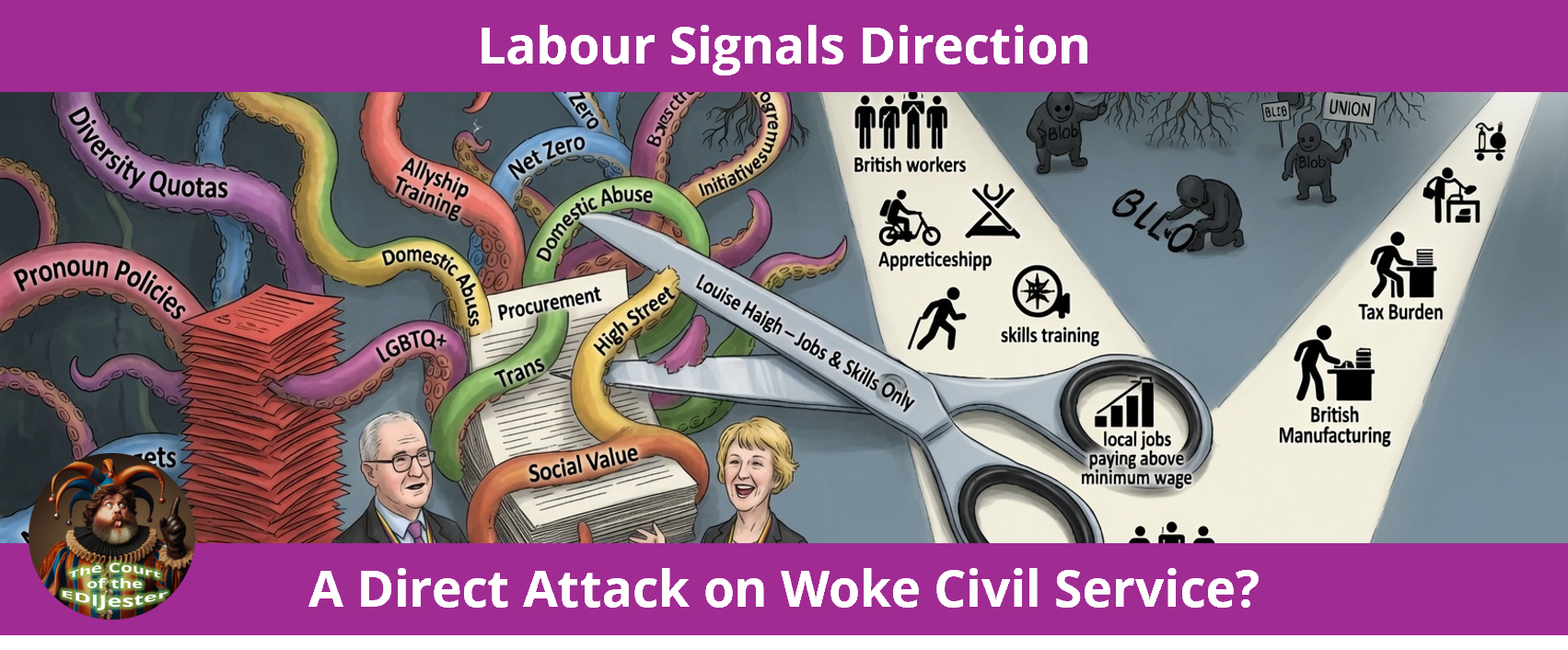
The Financial Times reports on the announcement from Lucy Fisher on the 4th of August what appears to be a clear attack on woke, EDI and the various machinations of the public sector and its equity driven social engineering.
The UK government has announced scaling back on the tendrils of behavioural control that are social value requirements built into an already impossibly long and complicated public procurement.
Under the existing model, companies bidding for central government contracts faced a wide menu of demands that went well beyond jobs and skills and directly into the agenda of behaviourist nudging and social control.
This was not specific in it’s requirements, but so nebulous that it became an ever expandable list of demands, exacerbated by the likes of Stonewall and internal affinity groups calling for “going beyond the law” in matters of policy and procedure.
Whereas large expenditure by the state should simply be an economic stimulus, it has morphed over the years into a social engineering project on a grand scale, using businesses to usher in whatever the pet govt project of the time.
These diktats fell into five broad categories...
Environmental and net zero commitments
Equal opportunity and diversity & inclusion-style requirements
Wellbeing and community initiatives
Crime and social issues, including domestic abuse programmes
A range of softer “social” programmes that were often difficult to measure or prove as genuinely additional
They are of course the goals of woke and those who capitulate to the demands of EDI/DEI.
Hidden in that list of 5 are all the useless training such as “Allyship”, “Decolonise” “Trans” and “LGBTQ+” along with any other nonsense criteria any public body fancied adding.
Louise Haigh has signalled a clear shift.
The new approach will focus social value ruthlessly on job creation, skills, and opportunities, raise the threshold so smaller contracts are largely exempt, and drop the more amorphous progressive and environmental criteria that many businesses found burdensome.
Now the list looks like this...
Job creation, skills development, and opportunities
Creating jobs (especially local)
Skills training and development
Opportunities targeted at people facing labour-market barriers (NEETs, care leavers, people with long-term health conditions, and similar groups)
Extra credit can be given for: Jobs that pay above the legal minimum wage and structured training or work experience (for example, 45 days work experience)
On paper, this is a meaningful simplification, in practice, its success will depend on the detail still to come.
The implementation will sadly be a meaningless gesture unless measures are taken in the upcoming guidance to eliminate the fatal flaw, that being the Public Sector Equality Duty.
Public bodies retain the PSED and well-established EDI processes, and we already know that these departments and their leaders are crafty ideologues who will rename and simply retain EDI/DEI and all its machinations.
Equality impact assessments, internal guidance, trainings, lanyard fests, affinity groups and days for this and that special identity.
The EDI/DEI cabals (The Blob) can expand interpretations of “under-represented groups,” reframe old diversity requirements, or apply informal pressure on suppliers.
This systemic problem in the public sector is not going anywhere, they will still be able to factor in the usual EDI/DEI bloat, just by renaming alone.
Without a clear list of “don’ts”, as in explicit instructions that the old categories must not be reintroduced as scored criteria or soft expectations, the underlying bureaucracy is well placed to fudge the reform.
And fudge it they will for these believer traverse the public sector landscape like hall monitors at a school.
A positive direction to prioritise jobs and skills is welcome.
But unless the autumn guidance draws tight boundaries and ministers enforce them, much of the old multi-criteria approach risks surviving in new forms, and if we are not careful with renewed vigour.
The difference between real change and cosmetic adjustment will be decided by how specific and restrictive the final rules are, but unless Haigh and Burnham tackle the EDI/DEI systemic infection in the Public Sector this welcome direction is simply a compass point with no real direction.
What would make the reform more meaningful is worth pondering.
A tightly restricted menu of allowed social value criteria (essentially only jobs, skills, and clearly defined labour-market disadvantage).
Explicit statements that certain previous categories (net zero as scored social value, domestic abuse programmes, high-street initiatives, broad diversity/EDI metrics, etc.) must not be used as scored award criteria.
Strong guidance limiting how far PSED can be stretched in procurement.
Monitoring and challenge mechanisms so that departments cannot quietly reintroduce the old approach.
All of this would help, but until Haigh and her team go after woke with the precision of a brain surgeon excising a tumour, this is sadly just political window dressing.
The real test is what the autumn guidance will actually say and whether any enforcement within the public sector follows.
Just how will this keep the EDI/DEI pushers at bay?
Only time will tell.